Tuesday, November 15, 2011

A Loan-Free Education

When I saw the title, "Financially Needy Students Welcome! (But Don't Let Them Know)," I knew I had to check it out as I researched a paper related to this topic back in 2008. I was not at all surprised that the author was Laura Perna, whose research I am familiar with (and I'm positive I cited her in that paper I wrote in 2008). Anyhow, the gist of the article is that it is possible for low-income minority students to get free educations from elite institutions.

I remember that back in 2007-2008 there was a flurry of publicity in the Chronicle (and elsewhere) about all these universities that would guarantee families making less than a certain amount of money a loan-free education. What was impressive to me was that they weren't just for students that would typically be classified as needy - many colleges (Dartmouth, Cornell, Stanford, etc.) were providing loan-free education for students whose families made less than $100,000, which I thought was a pretty high ceiling for such an offer. -I wonder if this is still the case after the economic downturn.

What are my thoughts? I thought you'd never ask.

In the article, Perna mentions that these elite universities have only about 10% of the student populations are from families that make less than $35,000 a year. In questioning why this is the case, she points to the fact that this information is not really available public knowledge on their website, but rather, something that was announced for the sake of publicity at some point in time. Thus, providing loan-free education to students with great financial need really isn't a priority for the university so much as the institution wanting 1) the publicity for providing the opportunity and 2) to be able to "keep up with the Joneses."

Though I do agree that academically competitive students whose families make less than $35,000 a year face many challenges that likely prevent them from applying Ivy League schools, I don't think the lack of information is the largest problem. If elite universities want students from any particular population, they can get them. I think the problem is that these institutions don't want to admit more than 10% of students from this socioeconomic group. If you are working hard to recruit students to keep your university at #1 or #2, you want to continue your legacy, maintain legacy connections, and keep the money coming in. Though I'm sure the Ivy's were hurt the least due to the economic downturn, they were still hurt, and as mentioned in one of our texts, there is no such thing as an excess of money in higher education. -Now I'm not saying I agree that universities should allow only 10% of students from the lowest socioeconomic quintile in...I'm just saying that 10% seems to be the magic number these universities are happy to maintain. Perhaps it's enough diversity to be diverse in a socioeconomic sense, and enough for the administration and trustees to feel they are doing something good for society.

Though I agree that low-income students likely don't consider private institutions in general due to a lack of knowledge about financial aid (an only an awareness about sticker prices), there are more reasons these students don't consider elite institutions, like:
1) Location - low-income students (particularly minority) students are more likely to want to go to school close to home, sometimes for cultural reasons, but often because they think the only way to afford college is to live at home while commuting to school.
2) Logic - low-income students just figure they won't get into the Ivy League schools and take advantage of options at state schools (particularly their local state school) that provide full scholarships.
3) Academics - low-income students often go to public schools that just don't provide the kind of college prep education necessary toget them into elite institutions. This includes fewer AP options, lower standardized test scores, and an overall lack of college counseling. Low-income students that are at the top of their classes at low-income public schools still don't compare to students attending private prep schools.

So who is at fault? What is the problem? Clearly, there are many problems. I think some of it comes down to the public K-12 education system that isn't able to provide the best education for their students. Some of it is that these elite institutions are not only incredibly selective due to the large volume of applications they receive), but are selective due to the fact that they only select a small portion of students that have not grown up privileged. I also think that while administrators at these institutions do not ever say it, they are private institutions and truly are not obligated to admit low-income students and give them (essentially) full-rides.

I think that elite institutions do have a responsibility to admit low-income students (even though they technically don't have to) and that socioeconomic diversity is just as important as racial/ethnic diversity. I also hope that high-achieving, low-income students become aware of these opportunities and try for them, because a full-ride to Stanford would be more enriching on so many levels than a Regent's Scholarship at UH.

How Cool!

Watching Rachel Maddow tonight I found out about something so completely and entirely awesome....the Occupy Wall Street Library! Sadly, when Bloomberg had Zuccotti Square evacuated, the library was taken (though some books are apparently being stored safely). This wasn't just a little library. There were over 5,000 volumes set up, and volunteer librarians cataloged them all! OWS considered their library to be "public," so in addition to the OWS folks, anyone who wanted to borrow a book could do so - some of whom were parents and children who lived in areas with underfunded/poor libraries.

Here's some info about the library! Click me!

Want to search the catalog? Go here

When I finish my thesis, I'm going to start into my library and maybe I'll even catalog it!

Wednesday, November 2, 2011

It Always Comes Down to Politics.....

I've been known to make arguments that almost any opinion about education (what to teach, who should teach, who should learn, where should the learn, how much does it cost to learn, etc.) comes down to political ideology. Is higher education a right or a privilege? Who should pay for education? --I think it comes down to politics. So what exactly do these people say? I thought you'd never ask. Here is my summary of what some politicians believe or are trying to achieve:

1) Ron Paul, 2012 GOP Primary Candidate seems to think that higher education is a waste of money, that federal aid for higher education is failing, and he recommends cutting one trillion dollars from the federal budget, including education. He also mentioned that if he were president, he would cut federal loans entirely. I think it's interesting that Ron Paul sees the problem that students are one trillion dollars in debt (college loan debt), and decides the solution is to cut that amount of money from the federal budget. Hrmmm...so who exactly are you trying to help here? It's not those students who are the 99% that are suffering in debt, and it's not the students that actually need the aid for college. This is what I call a logic fail.

2) Herman Cain, 2012 GOP Primary Candidate thinks that aid for college should come from the state government and from communities, not from the federal government. It's interesting that he recommends that students who cannot afford institutions with high sticker prices should make "different choices as to the schools they go to," and says, "they might have to work a little harder." First of all, these students oftentimes DO choose community colleges and they still need that federal aid...and in my opinion, these students should be given more options other than just community colleges! Second, most of them are working harder - working part-time or even full-time and may even be supporting families. This, of course, means that they have less time to devote to their education - an education that they were already disadvantaged to from the beginning! Lastly, where exactly are the states and "communities" getting all this money from?

3) President Barack Obama has made a plan to lower interest rates for students who consolidate under the government's Direct Loan program, and will allow low-income earners a reduction in their payments. While I do see both of these opportunities to be good things, I just don't think they are enough. I do not think it is realistic to demand the government do a college loan bail-out, I kind of think the people are owed this since the government bailed out the banks! Surely if you can bail out the banks you can bail out your own citizens! No? I think these options are steps in the right direction, but there needs to be more done. I really hope this wasn't just a small something Obama could do to gain votes from people...I hope this is a sign that the current administration is aware of the problem of college debt and that even more options will be forthcoming. Here's to hope.

Friday, October 28, 2011

College Giving

So, according to this article, there's good news and bad news with regards to college/university giving. The good news is that according to The Chronicle of Philanthropy, 25% of organizations on the "Philanthropy 400" list this year were institutions of higher education. (The "Philanthropy 400" is apparently a list of the 400 organizations that raise the most money...I had to look that one up.) So, the good news is that the top 400 organizations received an increase of 3.5% overall compared to 2010...and while this is nothing compared to what they were receiving prior to the recession, at least the earnings seemed to have increased.

Unfortunately (from my perspective, at least), the organizations that top the list are institutions that likely do not have the kind of need for giving the way other many other institutions do. (At the top of the list are Stanford, Harvard, Amherst and Johns Hopkins.) While giving for these institutions may have increased (for Amherst significantly so!), I'm guessing that there are other institutions out there that were previously dependent on alumni giving that are suffering because they are not able to generate the kind of revenue they were able to generate prior to the economic downturn.

I wish I could see the full list, but I do not have a subscription to The Chronicle of Philanthropy...it would be interesting to see the types of institutions on this list. I would bet that many of them are institutions that are considered by USNWR to be "the best" institutions. Still, I'm sure if you asked any of these institutions on this list, they would all say they still need more. Institutional endowments across the nation took a hit in 2009, and I think that an article we read in class this semester is correct in that there will always be a need for more money (even in more economically prosperous times), and that will always be able to be put to use. There is no such thing for an institution to receive too much money.....

Thursday, October 20, 2011

Liberal Arts Colleges in the Current Economy

I thought this was a great article, and though it may not be the most concerning topic to most people within the field of higher education, I was definitely interested in it because I graduated from a women's liberal arts college and did my budget narrative on a liberal arts college!

Basically, the article discusses Smith College and their "Future Initiative" plan that you can find here. Like Mount Holyoke College, Smith is an undergraduate liberal arts college for women, and they're located roughly 20 minutes north of MHC. Smith has a larger endowment than MHC and is more well known than MHC (at least on the western side of the country), but what concerns Smith tends to concern MHC as we are similar institutions with similar priorities.

Like one of MHC's strategic planning reports, Smith's "Future Initiative" discusses the fact that the current model (both educational and financial) are not sustainable. (Though I would argue the reason the educational model isn't sustainable is only because it is financially unsustainable.) Liberal arts colleges, even those with endowments like Smith and MHC should be concerned about their futures because large changes (such as adding programs that may be less competitive but will being in money, or adding online instruction) could change the mission of the institution, even if they can bring in money. These colleges need to think through their plans with their communities (including alumnae and students) to determine their courses of action.

I remember when I was at MHC I was concerned about the move towards centralized dining. While dining is not completely centralized, something does change about the feeling of community when you can't just roll out of bed in your pajamas and get a hot breakfast in your residence hall. Clearly, this is something one may not see as a big deal, but these are the small changes that may become large changes in the future.

Small classes taught by professors (who make good money!) are also a hallmark of the liberal arts experience, but the fact that these instructors receive only a small fraction of research grants and contracts that research institutions do is almost like a financial double-whammy. While technology plays an increasing role in college life, how should professors incorporate technology into learning? Should there be classes held online? While I can understand students at large universities taking an occasional online class, I can't even imagine taking an online class at an institution like MHC unless it were taught by a distinguished professor that is physically in a different location...and even then, I would probably argue that the students should meet together in person in a classroom while the instructor was broadcast into the classroom.

I clearly don't have the answers, but a liberal arts education means something, and I am concerned that many options to increase revenue may detract from the missions of these institutions. Of course, in this economy, I am sure we will hit a point where we no longer have a choice...and it is definitely a good idea to try to brainstorm ideas now, before it's too late.

Tuesday, October 18, 2011

Affordable Excellence

I thought this article was interesting, as it is about financial aid (need vs. merit) at a public liberal arts college that is competitive with both public institutions and liberal arts colleges. The main gist of this article is that St. Mary's College of Maryland will be getting a new VP and Dean of Admissions & Financial Aid, Patricia Goldsmith, and the goal of the institution is to increase both access and excellence.

While this article is specifically about this institution, I think almost every institution would say that they would like to be able to increase access and excellence, but the question is "How?" In the article, the author discusses institutions that have opted to be "need blind" as well as institutions that will give merit grants to all students that meet certain academic criteria (though critics argue this is what institutions were doing all along anyway). I have a hard time understanding how a public "honors" college that really has that private liberal arts college feel can exist and continue to be affordable. With a student:teacher ratio that rivals many private liberal arts colleges, and an almost completely residential community (90% of students live on campus), the faculty and staff salaries (especially if there is staff tenure in this state) as well as the maintenance of the campus must be very expensive!

At least tuition and fees for St. Mary's College seems to be a "good deal" (relatively, of course) at $14,400 a year for residents, though non-resident tuition is significantly higher at $26,500 a year. I think that going forward, St. Mary's needs to find a way to figure out the direction they want to head in and try to stay true to their mission. Since they are an "honors," college, academics should be their main focus, but as a public institution, their next priority should be accessibility for in-state students. Though I understand the need to use tuition discounting and that there is a benefit to having students from various geographic locations, I think this institution needs maintain its accessibility particularly for in-state students, particularly those with high levels of financial need.

Saturday, October 15, 2011

"Republicans Push Pell Changes"

According to this article, House Republicans proposed to maintain the dollar amount of the maximum Pell Grant at $5,550 but make several other cuts in the program, including the following:
  • Students attending at a less than half-time status will no longer be eligible for grants
  • Students can receive the grant for only 12 semesters (down from 18 semesters)
  • Students eligible for less than 10 percent of the maximum grant would receive nothing
  • Programs for colleges serving significant numbers of black students, Asian-Americans and Pacific Islanders, Alaskan Natives, Native Hawaiians, and Native Americans (as well as tribal colleges) would be eliminated
  • The budget for Hispanic serving institutions would be cut by 83%
  • The budget for HBCU's would be cut by 36%
My thoughts?

Well, let me start by saying that I'm completely biased because if balancing the budget were my job, I'd do my best not to meddle with education (other than to improve it)...HOWEVER, if I were required to make cuts to Pell Grants, I would not make the above changes. Who do these proposed changes hurt the most? The students that need the aid the most, of course.

Historically underserved minorities are the students that tend to live at the lowest levels of socioeconomic spectrum. These students are also more likely to need to work while in school (and may perhaps register for fewer credits), and may take longer to graduate whether it is because they began their academic journey at a community college or because they need to work while in school. I think for many of these students, completing a degree in 6 years may be unrealistic. I can definitely see students within the UH system suffering if these changes were made.

As we have recently read in class, while the focus of early efforts to increase higher education access was for those who had the greatest need, the fact that many of these programs have expanded to include the middle-class may be (particularly in this case) hurting the students that need the aid the most.

I am not sure exactly what the income cut-off is for receiving a Pell Grant, however, perhaps this cut-off could be lowered somewhat so students in the upper middle-class would only be eligible for grants while only the lower class and lower middle-class would still be eligible for Pell Grants. --Just a thought.

Monday, October 10, 2011

The Conspiracy of the College Conspiracy

So I actually came across this video while on youtube one day and it just smelled fishy from the beginning. I watched parts of it here and there and aside from the fact that I completely disagree with the ideology it claims to represent (i.e. "College education is the largest scam in U.S. history!"), I found so many facts that were used incorrectly, as well as several phrases with a heavy emphasis on "might" and "maybe." From the beginning of the video, the writers were cramming facts and scare tactics down your throat. They used the average debt of graduating from a private school as the "average debt" overall, and tried to help us understand why tuition "needs to be increased" based on the "friend" of someone who is running a for-profit institution. Um...fishy anyone?

Throughout, the video is pushing gold stocks which is unsurprising, given that (after just a little bit of poking around), I find out that the "National Inflation Association" is just a group that is trying to scare the public to scam them into buying stocks in gold and silver. Go figure the piece was written by Jonathan Lebed, a well known stock scammer.

The Chronicle decided to dedicate a little article to the video here. I hope that people don't need to read the article to realize the video is just a scam.

Of course, given the fact that we are in a very scary economic time, people may be more likely to actually buy into the fear. While people are beginning to occupy Wall Street...with several "Occupy" events going on around the U.S. (and the world) and the whole 99% campaign, there are tales out there that are true about being college educated and unemployed. I just hope that people don't buy into the fear mongering of the NIA.

Higher Ed in South Korea

Okay, so the focus of this article is on teaching in South Korea, and the observations of an American professor in South Korea, however, there are some interesting statistics related to higher ed finance here:
A full year of tuition and living expenses for a midranked public university consumes, on average, more than 45 percent of a family's annual income. The costs are higher if the institution is private and is considered the equivalent of an Ivy League institution. Over the last three decades, tuition costs borne by South Korean families have increased by a factor of almost 30 with an especially sharp jump in the last decade. Household incomes have not increased at the same rate.
So basically, here in the U.S., I would argue that while higher education still is not a "right" the same way K-12 education is, higher education in the U.S. is seen as a "public good." In South Korea, it appears that education is still a "private good" and is primarily for those who can afford it.

The article mentions high rates of college and high school student unhappiness, as well as high rates of suicide. Interestingly enough, as I read the article, I could not help but draw parallels between these students and students at MIT (I had a friend who went there). Perhaps the combination of student competition (where professors actually pitt students against each other for grades in class) and long study hours are to blame. I also found that many of my Asian friends (particularly males) who attended the best private schools here and received the highest grades here also spent their first year of college at Harvard and MIT partying, who seemed to be (much like the Korean students) just celebrating being done with high school and the fact that they got into Harvard and MIT.

While I don't think this article can really be generalized in any particular way, the unfortunate circumstances of higher education in South Korea (and by this, I mean the constant hours of studying in primary and secondary school, as well as the fact that college is only seen as a private good) do seem to reflect the nation and the priorities of the nation. Perhaps a more efficient education system could help lead to a more efficient government??? Hrm...we may never know.

Sunday, October 9, 2011

Thanks for Ruining FA for the rest of us.....

Well, I'm glad some democrats are calling for a "crackdown" on the financial aid fraud that is going on in the country. First of all, here is the article I'm commenting on, though for greater background on exactly what these looters are doing, read this. Oh, and if you're interested, here's the letter written by the democrats calling for a crackdown on these criminals.

Basically, what these "ringleaders" do is find "straw" students (fake students) to enroll in online courses at various colleges, and apply for financial aid for them, take these "fake" courses, and then receive a kickback of $500 to $1500 worth of Pell Grant money from these phony students. Since the courses are online and it's difficult to verify that those online are who they say they are, the ringleaders have been able to get away with millions of dollars worth of fraud!

I think there are several difficulties in catching these ringleaders. Rio Salado got lucky (so to speak) and was able to catch someone because a financial aid officer noticed the same handwriting on several applications...but what if he hadn't? How do you go about catching these kinds of people? According to the article, some current investigations involve up to 400 people!

While I think there can be some benefit to online courses, the fact that there is no way to know who is on the other end is a problem, and I think we are still a ways away from really doing anything to improve the process. Also, if online classes are very large and involve little involvement beyond multiple-choice quizzes and exams, it is even easier for criminals to capitalize on these opportunities.

I think the biggest question, aside from "How do we catch these criminals?" is "How can we verify that students are who they say they are in online classes?" I think we're several years away from an answer.

Socioeconomic Diversity at Top Colleges and Universities

So, in this article, the author Catharine Hill (President of Vassar College) argues that selective institutions should increase their socioeconomic diversity to have more than 10% of the student body from the bottom 40% of the income distribution. Okay, that sound good to me. How does she recommend colleges do this? By having the U.S. News and World Report include socioeconomic diversity in their rankings. My feelings about this are somewhat mixed, so let me explain why.....

First, I think that it's important to note that the colleges and universities that Hill is talking about are the top institutions in the nation that have likely suffered the least in the economic downturn. These institutions are need-blind and already provide great financial aid packages to the students that do attend, in some cases, eliminating loan aid from financial aid packages entirely.

When students from low SES groups attend these universities, I am going to bet that these students are academically prepared for these institutions, and will typically graduate within 4-years at these schools (which is common). When the culture of an institution is to prioritize academics and graduate within four years, I'm sure the students from the lowest SES groups do the same, perhaps with even more focus because they are aware of the wonderful and rare opportunity they've received.

I also agree that it would be great if more students from the lowest SES groups could attend these "elite" institutions of higher education. I've always believed that SES was a greater divider than race and ethnicity, and that "elite" institutions should recruit these students and provide better academic options for them.

Unfortunately, while changing the criteria in the USNWR may lead to the results Hill is talking about for these elite institutions, I'm not sure whether the overall result will benefit students from low-SES groups on the whole. Let me explain. Schools like Harvard, Stanford, and Amherst will always find their way to the top of the rankings one way or another, particularly because of their reputations. What about institutions that are ranked much lower but build their strategic plans around improving in the rankings? I can't remember many off the top of my head, but Baylor is an example. Their strategic plan, "Baylor 2012" included goals that directly mimic USNWR's criteria and they had spent well over $200 million by 2007! My concern is that schools that aren't in the "elite" tier may admit students from low SES groups just to move up in the rankings without considering the ramifications. Are these students actually academically qualified? Will they succeed? Does the academic culture of the institution encourage students to prioritize academics? What is the graduation rate?

I think there are already many institutions in the country that are not "elite" that already are working very hard to try to serve students from low SES backgrounds (i.e. community colleges). I think that elite colleges should work hard to recruit more qualified students from lower SES backgrounds. I am concerned, however, that institutions may end up admitting these students just to try to move up (or just to keep up) with USNWR rankings and may not have the support these students need. While admitting students from low SES backgrounds should be a priority for all schools (particularly elite institutions), I think that actually graduating these students should be a bigger priority.

Sunday, September 4, 2011

Goodbye Summer, Hello Fall

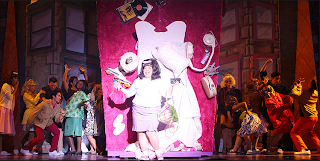
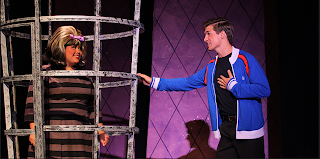
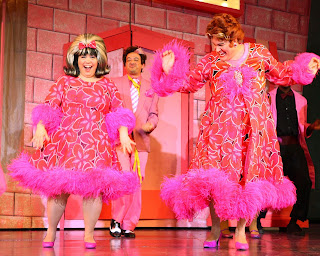
Well, this summer I had my 5 minutes of fame playing the lead role in a production of the musical "Hairspray." I've always maintained that the thrill of theatre for me is not in doing the shows for the audience and feeling all that energy and applause, but rather, the rehearsal process where you're learning the music, thechoreography, memorizing lines, and trying to remember the staging. Yes, even in my extracurricular activities, I'm most satisfied when I'm giving mybrain a good workout.

I was somewhat concerned that after the show ended I would feel down, really miss the show, and want nothing more than to find any way possible to just do more shows and perform. I'm happy to report that this wasn't the case and I don't know if I've ever been so excited to return to classes, with my head always in a book, and surround myself by academics, coffee (which I gave up over the summer to keep my vocal cords hydrated) and libraries. It also confirmed for me that this is where I belong.

Farewell, summer!!!


Hello, fall!

Friday, January 28, 2011

Note to Self

To Do:
-Poem due Sunday
-Abstract due Tuesday
-E-mail Dr. H
-Read article for Thursday

Done:
-Read article for Tuesday

Saturday, January 22, 2011

An introduction to feminist research methods

The three texts we're using this semester in feminist research methods are:
  • Feminist Methodologies for Critical Researchers: Bridging Differences (Joey Sprague, 2005)
  • Feminist Research Practice: A Primer (Sharlene Nagy Hesse-Biber & Patricia Lina Leavy, 2007)
  • Feminist Methods in Social Research (Shulamit Reinharz, 1992)
Thus far, we've been assigned the introductions for each text, and I think they each provide interesting perspectives and will be great resources in the future. In addition to these texts, we'll have some great guest speakers as well as other articles to read.

From what I've read thus far, I really like the Shulamit Reinharz text...and the Feminist Research Practice seems to be a very accessible read. Here are the summaries of what I've read thus far:

Joey Sprague text, Ch 1, "The Field of Vision"

It seems to me that the overall goal of this book is to teach feminist methods in order to make society more just (a major tenant of feminist methods). One problem Joey Sprague sees is that the word methodology can convey either boredom or intimidation -- neither of which are good starting points doing research to make the world a better place. The text is focused specifically on feminist research methods due to: the feminist history of critiquing prevailing assumptions, experimenting with alternatives, and that gender is an important social organizer and we need to take action (not just understand the way society works).

There is a discussion of "how we do research" and discusses Sandra Harding's three elements of research: epistemology, method, and methodology. "A methodology works out the implications of a specific epistemology for how to implement a method" (p. 5).

The remainder of the discussion in this chapter is about the researcher and their means for expressing their observations...and how both can be problems in the world of social research and what feminists are doing/can do to remedy this. Some of these problems include: basic research as more valued than applied research, a hierarchy of research topics, a tendency to "study down," and "ask questions that make inequality seem either natural or the responsibility of those on the downside of social hierarchies" (p. 12), reliance on logical dichotomy (employing dualisms the make observations seem mutually exclusive), abstract individuation (discussing the individual out of their context), objectification, using abstractions and jargon, hiding the researcher, as well as publishing norms and standards. The chapter closes by giving an overview of "what is to come" as well as discussing the importance that researchers are mindful of 1) how knowledge is produced and 2) how methods are used (technically and politically).

Abigail Brooks & Sharlene Nagy Hesse-Biber, Ch 1, "An Invitation to Feminist Research"

I won't go into great detail about this chapter as much of it is familiar to me, but the overall impression I got from this chapter was that there are many takes on feminism and many takes on feminist research methods.
  • People's perceptions of feminism are informed by their lives - white, middle class women may not understand the importance of feminism
  • Assumptions are made about feminists and feminism, and thus, women's issues prevail (i.e., salary, underrepresentation in certain fields, affordable childcare, poverty, and violence)
  • The feminist critique of positivism
  • Sandra Harding's "strong objectivity" (using marginalized voices to be the starting point for knowledge and develop stronger standards)
  • Discussing feminist empiricists, feminist alternatives to positivism, and differences in feminist theory and practic
  • Sandra Harding's "strong reflexivity" (the interaction of the observer with the observed can be positive and can help one gain stronger objectivity)
Shulamit Reinharz, Ch 1, "Introduction"

This book is a very thick book and Shulamit Reinharz seems to have put much effort into gathering multiple perspectives. Dr. C-L was right, though it was published in 1992, it has much to offer. She gives us different visions of feminists, different ideas about methods, and some feminist history. The most fascinating things I found in this chapter were: 1) her discussion of men and the idea of the male feminist/male feminist researcher and 2) the examples she picks for her book are from those who self-identify as "feminist."

Can a man be a feminist? Can a man contribute to feminist methodology? I think there will always be disagreement about this, but I think there is a difference between a man who claims to be a feminist and a man who claims to write accurately about women. This makes me think about disability studies. People without disabilities do research in the field of disability studies. Granted, one would hope that the voices of people with disabilities is expressed - by both researchers with disabilities and not - but people with disabilities can do research to help the field of disability studies. --I just think they can't claim to know what it means to actually be a person with a disability, the same as a man cannot understand what it means to be a woman.

Regarding the choice to pick feminist research to include in the text based on the researcher's identification as a feminist is an interesting decision. True, it may be more accurate than her own labeling of feminists based on her own opinion, but what about those that may be presenting great feminist research but do not want to identify as such (due to stigma)? It also probably would have been difficult (and perhaps anti-feminist) to try to construct a scale of what feminist research is based on what feminists say -- I mean...I don't even know if that's possible.

***********************************
I am looking forward to class this week...the following week is epistemologies...I hope I'll survive!

Monday, January 17, 2011

Spring 2011, Faludi

Quick post as I don't have the time to go into detail, but I read an article that got me all riled up. Welcome, new semester...new semester, for which I don't yet know what courses I'm taking!

Though I agree with what Faludi is saying in "Blame it on Feminism," who is talking about out the feminism backlash, I have to say that though I am gay and a woman (and though they are inextricably linked), I feel more anger in my womanhood than as a lesbian. Perhaps this is because I feel most of the negativity I've felt in my life has circled around me being a female as opposed to me identifying as gay.

Maybe it's also because there are places where it's okay to be gay in the US (urban areas, etc.), but being a woman makes me always feel like I'm one step behind, or lower in hierarchy in so many areas. Or perhaps it's because of what Faludi is talking about...everyone knows that the gay rights movement still has a long way to go -- nobody is arguing against that. Yet there are people in this world who believe (falsely and injuriously) that women have achieved equality -- which is something I can honestly say I have never felt, something that, no matter what the media tries to tell me, I will not be able to believe.

(Side note: I am aware that many people are against gay rights, but you know what? Many people are against women's rights. The difference is that people refuse to acknowledge that they are against [passively or actively] women's rights...maybe because they're afraid of losing the female vote.)

How dare anyone blame feminism! This frustrates me so much. It's like we're trying to be turned against ourselves!!! But I have faith, if only because I know that most women feel the same way as I do, even when the world (media, pop culture, etc.) is trying to convince them otherwise.

I am, above all else, a woman, and I am a feminist.

Saturday, November 27, 2010

Fabulous Day

So today isn't fabulous because it's "black Friday" or because it's the day after Thanksgiving.

It's fabulous because I found something amazing while reading The Chronicle today. Someone's response in something I read was that she was wondering what would happen when Maya Angelou passed and that this is the answer.

Start with the little piece on the Chronicle here:

Then continue to feast your eyes and ears and soul:

Stage


Walking

Mama (Get your tissues out for this one)


I'm pretty sure this is her, too


Another good one (performed at the New York Film Academy)


-Why she is the Youth Poet Laureate


--Mini film made based on her poem


Zora Howard. Remember her name.

Saturday, November 20, 2010

Philosophy, Social Theory, and Other Stuff

Recently I've been thinking about the many things I don't know and haven't studied (or have studied but don't remember) and how these unknowns could really add to my education. I feel the need to return to my roots of sociology, refresh my memory of classical and contemporary social theory, and look at them from the education perspective. I also feel the need to get a good overview of philosophy, something that I haven't studied. I took a philosophy of law class in college, but that course was very specific...I didn't get a broad background in philosophy. So I'm interested in learning about philosophy in the same way I'd like to refresh my social theory, and I'd also be interested in learning more about educational philosophies as well.

In my online searches, I've happily stumbled upon an introductory philosophy text (entirely online with links to youtube and everything) that I'd like to read. Do I really have the time for this? Probably not. Do I have other articles to be reading and other papers to be writing? Absolutely. --Is that going to stop me? No.

Getting started:

A. List the five or so most important questions or problems you think about.
-What is the purpose of life? (Specifically, the purpose of MY life...)
-What is the purpose of education?
-What does the future hold? (Overall, and specifically with regards to the fields of technology and education.)
-How can modern technological advances be used for "good" and for connecting people all over the world?
-How can I do good in this world in this life?

B. If you had virtually unlimited financial resources at your disposal what would you begin doing with your life?
-I would probably continue my education, travel a bit (hello, Greece!), and start up an organization to help educate disenfranchised populations or improve education on the whole.

C. What is Philosophy?
Philosophy is many things - a thought process, a belief system, a way to make sense of the world.

D. How do you use the term "philosophy"?
When I discuss the views/opinions I have on something that I've put a great amount of thought and research into. They are ideas I usually arrive at based on my experiences in life, and I usually maintain an openness about my philosophies - I am willing to consider new information to add to or otherwise inform my philosophy.

E. How do others use the term "philosophy"? Give examples.
Usually it is in reference to something someone has an opinion about (not really a philosophy at all) and usually something someone has pondered/experienced/learned from and about a great deal. Some people merely state an opinion and say that is their philosophy about something - for others it is more than mere opinion.

F. What good is philosophy?
Philosophy helps you think, helps you connect thoughts and experiences, and perhaps adds a certain type of value to your thoughts and experiences. It implies reflection at the least, and is often coupled with observation and/or experience, and can help give meaning to these thoughts/feelings/experiences.

G. What importance might philosophy have in your future?
Who knows!!!

Notes:

Relevance of Greek philosophy to modern times: At the time of Socrates/Plato, Greeks were transitioning from an oral to a literate culture, and people were beginning to question the myths that had been passed down over time. Now we are shifting from a literate culture to an electronic culture and "We are at the beginning of a period in which we are attempting to develop a morality for the new age."

Theory of education - Alfred North Whitehead:
-Romance
-Precision
-Generalization

Belief Systems
Different belief systems and periods: classical, modern, postmodern
--Starting with unconscious acceptance despite inconsistencies; acceptance of ideas from authorities; accept ideas from the desire to please/be accepted; postmodern culture promotes thought patterns that are uncritical and not reflective.
--Philosophy emerges when belief system cannot answer the important questions
--Students go to college believing that all claims are opinions and everyone can believe whatever they want (similar to cognitive development theory), they do not want to be disloyal and reject their belief system and also want to believe in eternal life (i.e. going to heaven).
--Insincere, uncritical tolerance

Thoughts:
Interesting discussion of the Matrix and the blue pill vs. red pill with regards to philosophical thought (& cognitive development?)

DONE WITH CHAPTER 1!

Thursday, November 11, 2010

Don't Mistake Correlation for Causation

Let me preface this blog by saying that yes, I am blogging to procrastinate, and no, this blog has nothing to do with school or class readings.

So you've heard the saying "don't mistake correlation for causation," right? So between my undergraduate major (sociology), minor (psychology), and my grad school education, I've taken roughly 6 courses that somehow relate to research methods, and about half of them have been quantitative. Well, I have always enjoyed the various examples I've heard of not mistaking correlation for causation because they are almost always funny. Anyhow, after watching an episode of South Park, I've got a new example!

Here are three examples of mistaking correlation for causation. I'll let you guess which one is the example from South Park.

1) Someone is doing research on shark attacks and they make a discovery. An increase in shark attacks occurs when there is an increase in ice cream sales, and a shark attacks disappear entirely when ice cream sales are at their lowest point. What do we need to do to prevent shark attacks from happening? Clearly, we need to stop selling ice cream!!!

2) A researcher is studying crime in an urban area and thinks there may be a way to lower crime rates in the city. In this large urban area, there have been several murders over the past year, but in a suburban area not too far away, there has been only one murder in the past five years. The researcher also notices that the large urban area has roughly 30 churches while the suburban area has only one. Isn't it clear why there is so much crime in the urban city? The abundance of churches!!!

3) In a small town in Colorado, a law is passed that bans the selling of fast food, which means that the local KFC has closed down. Another law is passed allowing for the use of medicinal marijuana, and this medicinal marijuana store has opened in the place of the KFC. In this town, (unbeknownst to the local doctor) men are purposefully exposing themselves to radio waves to induce testicular cancer so they can get prescriptions for marijuana. Due to the alarming rate of testicular cancer in town, the doctor argues that the KFC must be reopened because they did not have a testicular cancer epidemic when there was a KFC in town.


Wednesday, November 10, 2010

Interesting Reads

The course readings I've had recently for my disabilities studies class have been very interesting. I thought this week's topic of "Ethics and Politics" might not be as exciting as previous weeks, but I think this weeks readings provided perhaps even more issues to think about. The readings were mostly about eugenics (historically in the US, Britain, and Germany and the relation to modern-day prenatal testing), and the "mad" movement (which I had only been slightly familiar with).

Who has the right to decide that a life is not worth living?
At what point do people with mental illness lose the right to make decisions about their physical bodies?
-These are just a couple questions that popped into my head after the readings - questions that I know will be tumbling around in my head for some time.

Readings for my curriculum class have also been great. Right now we're reading some Parker Palmer and bell hooks. I have to say, though Palmer is indeed a good writer and is very, very full of passion and care, there's just something about bell hooks that jumps out and grabs me. Perhaps this is not the most relevant thing to be pointing out, but just the differences in the style of writing sort of separate their perspectives (which are in some ways very different, and in other ways, similar). I feel that every word, every sentence, every paragraph and chapter of Palmer is carefully selected and strung together with intent. There is a reason for every word and each idea builds. hooks on the other hand...well, her writing isn't haphazard or anything, but it is full of energy...it's like...her writing is actually charismatic. -Is that possible? I'm sure I'll have more to say about both once I've completed the readings, but it's so interesting to see the ways their two different perspectives complement each other.

Today I got to (just about) the end of chapter 4 in Palmer, and I have to say that I spent lots of time thinking about this chapter as I was reading it because I really identify with it. At first, I was wondering where he was going with his discussion of community (i.e. therapeutic, civic, and market) but I like where he ended up because I share his epistemological perspective. I mean...I always love talking about subjective vs objective thought, and the importance of the relationship of the "knower" with the "subject" and that there is indeed a relationship, not just among people in the academic community, but between people and inanimate objects and thoughts, such as the subjects we study, and the underlying questions or "secrets" that pull us into them. I understand that to some people, it may sound ridiculous, but I don't think being moved by ideas is any less "out there" than being moved by poetry, art, and music.

For example, I was so sure I was going to major in psychology when I went to college, and when I finished my first year, I had 20 credits in psychology. On a whim, I decided to take a sociology class and...well...I tossed my psych major out the window. Sociology really touched me...Merton, anomie, deviance, Goffman, the presentation of the self, social structures, social roles, hierarchy, social stratification...it isn't just the learner learning, and it's more than the student reaching out to touch the subject, it's the subject actually reaching out to pull you in. I also feel that way about education, and of course, as I've moved along in my education, I see the relationships among the different subjects I've studied, the relationships among people in my studies (faculty and peers), and even the connection of myself to what I'm studying. --I really feel Palmer in this one.

I've begun my research for my disability studies paper...I've found about 50 articles related to my topic, now I'm in the process of reading abstracts and weeding out what I don't need. I've already found at least four that go in the "not relevant" pile and I've gone through about ten. Hopefully I'll find a couple real gems, but none so far. I think ideally I'd like to address teaching, learning, and pedagogy...though I'm open to where the literature will take me. I just think that those three pieces are critical to curriculum, though, of course, institutional structure is, too. I'm thinking with teaching it's who is teaching and what is being taught, with learning it's who is/should/has learned from the disability studies perspective, what is taught, and where is disability studies taught (i.e. is it a silo department or interdisciplinary across curriculum), and with pedagogy it's the question of how disability studies is taught. Hrm. I'll need to ponder that a bit more.

In other news, I have a review due next Thursday for the Teaching Matters panel I attended last week. I've had a harder time thinking of connections to the reading than I did with previous panels, maybe because it feels like a rehash of the same material as the topics discussed at each session are very similar. Anyhow, I was thinking that a new dimension would be the benefit that not only first year students get from learning communities, but also the student mentors that lead these groups. --And guess what showed up in my mailbox today? The most recent edition of Educational Horizons that I receive through Pi Lambda Theta, and it's all about the benefits associated with being a student mentor! How cool is that?! Just the perfect piece I need!

Friday, November 5, 2010

Midterms and Beyond

Well, I managed to survive midterms. Well, it wasn't technically midterms, but it was a period of time (coinciding with midterms) where several papers/presentations/projects were due. I had my group presentation for my disability studies class, my article review, presentation, and review from a panel discussion for my curriculum class, and (fanfare, please) my final assignment, my big legal research paper for the ed law course I took an incomplete for last semester. I actually enjoyed writing it though at times the research was painful (it was difficult finding case law on my topic).

My attention can now be focused on my final teaching matters review, class readings, and final research papers. I've already started my research, as I have ideas of what I'm interested in researching for my classes. I'm pretty sure I'm going to do my curriculum paper on online pedagogy and my disability studies paper on disability studies in higher education curriculum. I thought there would just be too much overlap if I did something in disability studies and higher ed curriculum for both classes. Then there's my independent study. I've been pondering just doing a research paper on something I'm interested in related to technology and education but I've also been thinking of actually doing research based on a previous lit review.

I've been compiling data from a state DOE accountability site and just keep confusing myself with the data. What's important? What if what I thought was important wasn't? What if it doesn't mean anything? Can I use these numbers to help guide me to people/schools to interview? I've already dedicated a few hours to compiling the data. Hopefully I'll be able to make some sense of it.