Monday, October 10, 2011

Higher Ed in South Korea

Okay, so the focus of this article is on teaching in South Korea, and the observations of an American professor in South Korea, however, there are some interesting statistics related to higher ed finance here:
A full year of tuition and living expenses for a midranked public university consumes, on average, more than 45 percent of a family's annual income. The costs are higher if the institution is private and is considered the equivalent of an Ivy League institution. Over the last three decades, tuition costs borne by South Korean families have increased by a factor of almost 30 with an especially sharp jump in the last decade. Household incomes have not increased at the same rate.
So basically, here in the U.S., I would argue that while higher education still is not a "right" the same way K-12 education is, higher education in the U.S. is seen as a "public good." In South Korea, it appears that education is still a "private good" and is primarily for those who can afford it.

The article mentions high rates of college and high school student unhappiness, as well as high rates of suicide. Interestingly enough, as I read the article, I could not help but draw parallels between these students and students at MIT (I had a friend who went there). Perhaps the combination of student competition (where professors actually pitt students against each other for grades in class) and long study hours are to blame. I also found that many of my Asian friends (particularly males) who attended the best private schools here and received the highest grades here also spent their first year of college at Harvard and MIT partying, who seemed to be (much like the Korean students) just celebrating being done with high school and the fact that they got into Harvard and MIT.

While I don't think this article can really be generalized in any particular way, the unfortunate circumstances of higher education in South Korea (and by this, I mean the constant hours of studying in primary and secondary school, as well as the fact that college is only seen as a private good) do seem to reflect the nation and the priorities of the nation. Perhaps a more efficient education system could help lead to a more efficient government??? Hrm...we may never know.

Sunday, October 9, 2011

Thanks for Ruining FA for the rest of us.....

Well, I'm glad some democrats are calling for a "crackdown" on the financial aid fraud that is going on in the country. First of all, here is the article I'm commenting on, though for greater background on exactly what these looters are doing, read this. Oh, and if you're interested, here's the letter written by the democrats calling for a crackdown on these criminals.

Basically, what these "ringleaders" do is find "straw" students (fake students) to enroll in online courses at various colleges, and apply for financial aid for them, take these "fake" courses, and then receive a kickback of $500 to $1500 worth of Pell Grant money from these phony students. Since the courses are online and it's difficult to verify that those online are who they say they are, the ringleaders have been able to get away with millions of dollars worth of fraud!

I think there are several difficulties in catching these ringleaders. Rio Salado got lucky (so to speak) and was able to catch someone because a financial aid officer noticed the same handwriting on several applications...but what if he hadn't? How do you go about catching these kinds of people? According to the article, some current investigations involve up to 400 people!

While I think there can be some benefit to online courses, the fact that there is no way to know who is on the other end is a problem, and I think we are still a ways away from really doing anything to improve the process. Also, if online classes are very large and involve little involvement beyond multiple-choice quizzes and exams, it is even easier for criminals to capitalize on these opportunities.

I think the biggest question, aside from "How do we catch these criminals?" is "How can we verify that students are who they say they are in online classes?" I think we're several years away from an answer.

Socioeconomic Diversity at Top Colleges and Universities

So, in this article, the author Catharine Hill (President of Vassar College) argues that selective institutions should increase their socioeconomic diversity to have more than 10% of the student body from the bottom 40% of the income distribution. Okay, that sound good to me. How does she recommend colleges do this? By having the U.S. News and World Report include socioeconomic diversity in their rankings. My feelings about this are somewhat mixed, so let me explain why.....

First, I think that it's important to note that the colleges and universities that Hill is talking about are the top institutions in the nation that have likely suffered the least in the economic downturn. These institutions are need-blind and already provide great financial aid packages to the students that do attend, in some cases, eliminating loan aid from financial aid packages entirely.

When students from low SES groups attend these universities, I am going to bet that these students are academically prepared for these institutions, and will typically graduate within 4-years at these schools (which is common). When the culture of an institution is to prioritize academics and graduate within four years, I'm sure the students from the lowest SES groups do the same, perhaps with even more focus because they are aware of the wonderful and rare opportunity they've received.

I also agree that it would be great if more students from the lowest SES groups could attend these "elite" institutions of higher education. I've always believed that SES was a greater divider than race and ethnicity, and that "elite" institutions should recruit these students and provide better academic options for them.

Unfortunately, while changing the criteria in the USNWR may lead to the results Hill is talking about for these elite institutions, I'm not sure whether the overall result will benefit students from low-SES groups on the whole. Let me explain. Schools like Harvard, Stanford, and Amherst will always find their way to the top of the rankings one way or another, particularly because of their reputations. What about institutions that are ranked much lower but build their strategic plans around improving in the rankings? I can't remember many off the top of my head, but Baylor is an example. Their strategic plan, "Baylor 2012" included goals that directly mimic USNWR's criteria and they had spent well over $200 million by 2007! My concern is that schools that aren't in the "elite" tier may admit students from low SES groups just to move up in the rankings without considering the ramifications. Are these students actually academically qualified? Will they succeed? Does the academic culture of the institution encourage students to prioritize academics? What is the graduation rate?

I think there are already many institutions in the country that are not "elite" that already are working very hard to try to serve students from low SES backgrounds (i.e. community colleges). I think that elite colleges should work hard to recruit more qualified students from lower SES backgrounds. I am concerned, however, that institutions may end up admitting these students just to try to move up (or just to keep up) with USNWR rankings and may not have the support these students need. While admitting students from low SES backgrounds should be a priority for all schools (particularly elite institutions), I think that actually graduating these students should be a bigger priority.

Sunday, September 4, 2011

Goodbye Summer, Hello Fall

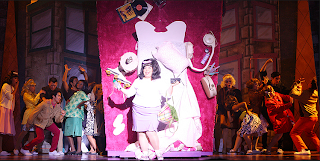
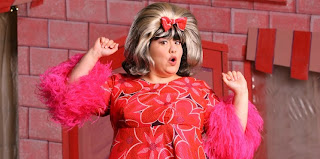
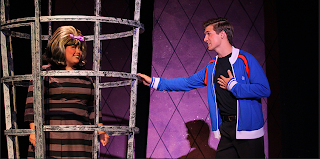
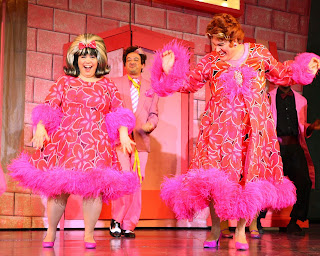
Well, this summer I had my 5 minutes of fame playing the lead role in a production of the musical "Hairspray." I've always maintained that the thrill of theatre for me is not in doing the shows for the audience and feeling all that energy and applause, but rather, the rehearsal process where you're learning the music, thechoreography, memorizing lines, and trying to remember the staging. Yes, even in my extracurricular activities, I'm most satisfied when I'm giving mybrain a good workout.

I was somewhat concerned that after the show ended I would feel down, really miss the show, and want nothing more than to find any way possible to just do more shows and perform. I'm happy to report that this wasn't the case and I don't know if I've ever been so excited to return to classes, with my head always in a book, and surround myself by academics, coffee (which I gave up over the summer to keep my vocal cords hydrated) and libraries. It also confirmed for me that this is where I belong.

Farewell, summer!!!


Hello, fall!

Friday, January 28, 2011

Note to Self

To Do:
-Poem due Sunday
-Abstract due Tuesday
-E-mail Dr. H
-Read article for Thursday

Done:
-Read article for Tuesday

Saturday, January 22, 2011

An introduction to feminist research methods

The three texts we're using this semester in feminist research methods are:
  • Feminist Methodologies for Critical Researchers: Bridging Differences (Joey Sprague, 2005)
  • Feminist Research Practice: A Primer (Sharlene Nagy Hesse-Biber & Patricia Lina Leavy, 2007)
  • Feminist Methods in Social Research (Shulamit Reinharz, 1992)
Thus far, we've been assigned the introductions for each text, and I think they each provide interesting perspectives and will be great resources in the future. In addition to these texts, we'll have some great guest speakers as well as other articles to read.

From what I've read thus far, I really like the Shulamit Reinharz text...and the Feminist Research Practice seems to be a very accessible read. Here are the summaries of what I've read thus far:

Joey Sprague text, Ch 1, "The Field of Vision"

It seems to me that the overall goal of this book is to teach feminist methods in order to make society more just (a major tenant of feminist methods). One problem Joey Sprague sees is that the word methodology can convey either boredom or intimidation -- neither of which are good starting points doing research to make the world a better place. The text is focused specifically on feminist research methods due to: the feminist history of critiquing prevailing assumptions, experimenting with alternatives, and that gender is an important social organizer and we need to take action (not just understand the way society works).

There is a discussion of "how we do research" and discusses Sandra Harding's three elements of research: epistemology, method, and methodology. "A methodology works out the implications of a specific epistemology for how to implement a method" (p. 5).

The remainder of the discussion in this chapter is about the researcher and their means for expressing their observations...and how both can be problems in the world of social research and what feminists are doing/can do to remedy this. Some of these problems include: basic research as more valued than applied research, a hierarchy of research topics, a tendency to "study down," and "ask questions that make inequality seem either natural or the responsibility of those on the downside of social hierarchies" (p. 12), reliance on logical dichotomy (employing dualisms the make observations seem mutually exclusive), abstract individuation (discussing the individual out of their context), objectification, using abstractions and jargon, hiding the researcher, as well as publishing norms and standards. The chapter closes by giving an overview of "what is to come" as well as discussing the importance that researchers are mindful of 1) how knowledge is produced and 2) how methods are used (technically and politically).

Abigail Brooks & Sharlene Nagy Hesse-Biber, Ch 1, "An Invitation to Feminist Research"

I won't go into great detail about this chapter as much of it is familiar to me, but the overall impression I got from this chapter was that there are many takes on feminism and many takes on feminist research methods.
  • People's perceptions of feminism are informed by their lives - white, middle class women may not understand the importance of feminism
  • Assumptions are made about feminists and feminism, and thus, women's issues prevail (i.e., salary, underrepresentation in certain fields, affordable childcare, poverty, and violence)
  • The feminist critique of positivism
  • Sandra Harding's "strong objectivity" (using marginalized voices to be the starting point for knowledge and develop stronger standards)
  • Discussing feminist empiricists, feminist alternatives to positivism, and differences in feminist theory and practic
  • Sandra Harding's "strong reflexivity" (the interaction of the observer with the observed can be positive and can help one gain stronger objectivity)
Shulamit Reinharz, Ch 1, "Introduction"

This book is a very thick book and Shulamit Reinharz seems to have put much effort into gathering multiple perspectives. Dr. C-L was right, though it was published in 1992, it has much to offer. She gives us different visions of feminists, different ideas about methods, and some feminist history. The most fascinating things I found in this chapter were: 1) her discussion of men and the idea of the male feminist/male feminist researcher and 2) the examples she picks for her book are from those who self-identify as "feminist."

Can a man be a feminist? Can a man contribute to feminist methodology? I think there will always be disagreement about this, but I think there is a difference between a man who claims to be a feminist and a man who claims to write accurately about women. This makes me think about disability studies. People without disabilities do research in the field of disability studies. Granted, one would hope that the voices of people with disabilities is expressed - by both researchers with disabilities and not - but people with disabilities can do research to help the field of disability studies. --I just think they can't claim to know what it means to actually be a person with a disability, the same as a man cannot understand what it means to be a woman.

Regarding the choice to pick feminist research to include in the text based on the researcher's identification as a feminist is an interesting decision. True, it may be more accurate than her own labeling of feminists based on her own opinion, but what about those that may be presenting great feminist research but do not want to identify as such (due to stigma)? It also probably would have been difficult (and perhaps anti-feminist) to try to construct a scale of what feminist research is based on what feminists say -- I mean...I don't even know if that's possible.

***********************************
I am looking forward to class this week...the following week is epistemologies...I hope I'll survive!

Monday, January 17, 2011

Spring 2011, Faludi

Quick post as I don't have the time to go into detail, but I read an article that got me all riled up. Welcome, new semester...new semester, for which I don't yet know what courses I'm taking!

Though I agree with what Faludi is saying in "Blame it on Feminism," who is talking about out the feminism backlash, I have to say that though I am gay and a woman (and though they are inextricably linked), I feel more anger in my womanhood than as a lesbian. Perhaps this is because I feel most of the negativity I've felt in my life has circled around me being a female as opposed to me identifying as gay.

Maybe it's also because there are places where it's okay to be gay in the US (urban areas, etc.), but being a woman makes me always feel like I'm one step behind, or lower in hierarchy in so many areas. Or perhaps it's because of what Faludi is talking about...everyone knows that the gay rights movement still has a long way to go -- nobody is arguing against that. Yet there are people in this world who believe (falsely and injuriously) that women have achieved equality -- which is something I can honestly say I have never felt, something that, no matter what the media tries to tell me, I will not be able to believe.

(Side note: I am aware that many people are against gay rights, but you know what? Many people are against women's rights. The difference is that people refuse to acknowledge that they are against [passively or actively] women's rights...maybe because they're afraid of losing the female vote.)

How dare anyone blame feminism! This frustrates me so much. It's like we're trying to be turned against ourselves!!! But I have faith, if only because I know that most women feel the same way as I do, even when the world (media, pop culture, etc.) is trying to convince them otherwise.

I am, above all else, a woman, and I am a feminist.